CO2 Reduction Iris Industry Solutions July 14, 2025
CO2 Reduction Iris Industry Solutions December 7, 2025
Iris Industry Solutions is committed to sustainable development and is convinced that good entrepreneurial performance is only achieved once there is a balance between People, Planet and Profit, or in Iris language: Betterness!
Iris Industry Solutions is C02 Performance Ladder level 5 certified and through its goals it strives to reduce its C02 footprint year after year.
OUR REDUCTION MEASURES ARE PAYING OFF!
A key principle here is to strive to minimize our carbon footprint. The annual mapping of our CO2 footprint offers Iris the opportunity to monitor its emissions and to steer measures to reduce CO2 emissions and make its business operations more sustainable.
We target a reduction in total emissions of 46% by 2030 (using 2019 as the baseline year) for following emissions:
- Scope 1 (direct emissions from the company)
- Scope 2 (indirect emissions from the company).
- Scope 3 (indirect emissions from third parties).
Iris Industry Solutions' CO2 emissions (scope 1 & 2) continue to depend on the amount of work and work method for removing an existing coating that may and can be applied to our projects. Iris Industry Solutions has expanded its foreign activities in France and the Netherlands, but our activities in the in-house workshop have also increased. This causes a slight increase in our carbon footprint as our workshops consume more energy than we consume on projects.
REDUCTION OBJECTIVES FOR 2030
With regard to our indirect CO2 emissions (scope 3), generated by our business with our customers and suppliers, we try to continuously reduce our footprint using our supply chain analysis.
Reduction target scope 1-2:
Towards 46% CO₂ reduction by 2030
Reference & Objective
- 📅 Starting year: 2019
- 💨 Scope 1 & 2 emissions in 2019: 2,762 tons of CO₂
- 🎯 Target for 2030: < 1,492 tons of CO₂
- 📉 Required total reduction: 1,270 tons of CO₂
- ⏳ Annual savings required: ± 212 tons of CO₂
Reduction target scope 3:
- 📅 Starting year: 2019
- Scope 3 emissions 2019: 885.07 tons of CO₂e
- Scope 3 emissions 2023: 21,331.30 tons of CO₂e
(That's an increase of a whopping 2310%)
So there is a strong increase due to better registration and increased activity. So it does not seem logical to us to take 2019 as the official reference (as previously determined for scope 1-2) and therefore we better build on from 2023 to 2030. For the 2026 we will then determine a new reference year for all 3 scopes.
We assume a reduction target of 20% by 2030, thus:
Goal: Reduce Scope 3 emissions by approximately 4,266 tons of CO₂e by 2030
REDUCTION MEASURES
With the following measures, we hope to further reduce CO2 emissions:
Measures & Impact scope 1-2:
| Measure |
| 100% fleet electrification |
| Machinery & blasting technology |
| Work from home & digital meetings |
| Monitoring consumption on site |
| Paint & grit optimization |
| LED & heating retrofitting offices |
PROJECTS
- use of vaporblast & induction instead of conventional blasting
- turning off machinery, lighting and heating when not in use
- grid recovery
- ordering correct amount of grit & paint
- additional focus on processing/reducing waste
- Monitoring machinery on site to reduce diese consumption
- optimization of Farrow Flow coupling on the blast pots for grit reduction
FLEET
- check tire pressure
- economical driving
- home office & digital conferencing
- switch to electric cars
- charging stations are provided at employees' homes as well as at the various sites
BUILDINGS
- LED lighting
- modification heating offices in Geel
Measures & Impact scope 3:
Iris Industry Solutions is actively committed to reducing its CO₂ emissions within Scope 3 - the indirect emissions resulting from the entire value chain. Between 2023 and 2030, we aim to achieve a reduction of 20%, good for 4,266 tons of CO₂.
Status in 2023
In 2023, our CO₂ emissions within Scope 3 have not been sufficiently inventoried. We do know that the biggest impact comes from transportation, waste streams, and commuting. This analysis forms the basis for our reduction strategy.
The intention is to revisit the baseline year for both scope 1-2 and 3 in 2026 so that the correct data can be used of these at the start.
Then we can also give a more detailed breakdown toward reduction of scope 3.
Target for 2030
Our goal is to 20% less CO₂ to be emitted in Scope 3 compared to 2023. This represents a savings of 4,266 tons of CO₂.
Concrete actions by 2030
Transport Optimization
- Consolidation of supplies: Fewer empty trucks, more efficient trips
- Route optimization through software: Smart scheduling reduces mileage and fuel consumption
Waste Reduction
- Packaging-free or recycled material As a requirement in procurement
- Collaboration with circular suppliers and zero-waste initiatives
Commuting
- Electrification of camionettes: Reduction of fossil fuels in daily traffic
- Encouraging sustainable mobility: Cycling, carpooling, public transportation
Measurement and demonstrability
Our progress is monitored through:
- GHG Protocol Scope 3 Analysis.: Annual inventory of chain emissions.
- KPIs: Sustainable purchasing volume and CO₂ impact of products
- Supplier Assessment: Annual evaluation of sustainability performance
- Software tracking: For transport efficiency and trip recording
CONTINUED FOCUS
The results and objectives of our sustainability system are presented in our sustainability report and our policy statement puts the focus on permanently seeking new reduction opportunities.
In 2024–2025, we started two new chain analyses: Farrow Flow link and reduction of paint (waste)
A chain analysis has been drawn up on reducing grit by means of the Farrow Flow coupling and reducing paint (waste) at the shipyards.
Objective:
Due to the potential for CO2 reduction and Iris's influence, Iris has decided to use the savings potential identified in the chain analysis for blasting with the Farrow Flow coupling as a target for the chain. The target is as follows:
"Iris plans to equip 100% of the blast pots with the Farrow Flow coupling by 2027."
2025: Modify 50% of blast pots with Farrow Flow coupling
2026: 75%
2027: 100%
Paint
The concentration of greenhouse gases in the atmosphere is responsible for global warming, so we need to reduce our emissions as quickly and as broadly as possible. Defining clear and measurable reduction targets is the best way to start. A reduction plan with specific actions and team responsibilities will help the organization make rapid and meaningful progress.
As part of the chain analysis, Iris Industry Solutions must set a target. Although the feasibility of switching to other types of paint and coatings can be evaluated, Iris has little influence on this measure. The type of paint is usually determined by the customer. As far as waste treatment is concerned, the techniques mentioned are not yet widely used and are therefore not easy to implement. The most relevant objective would therefore be to reduce waste.
The results of the chain analysis show that the majority of emissions come from the production of paints and coatings. The estimated percentage of material waste during production is approximately 13 %. By working to reduce the amount of paint and coatings wasted at the production site, the purchase of raw materials can be reduced.
A relevant objective for Iris Industry Solutions is therefore to reduce the amount of new paint/coatings that are disposed of as waste. A scenario calculation has been made for a reduction of 10 % in paint waste. This reduction has an impact on the entire life cycle. Less paint waste would lead to less paint being purchased, less transport of new paint and waste paint, and less waste that needs to be processed. For the same production, i.e., the same amount of paint/coating supplied and with a 10% reduction in paint loss, CO2 emissions during the life cycle of the paint/coating can be reduced from 1111.7 t CO2eq to 1091.9 t CO2, which represents a reduction of 1.7%.
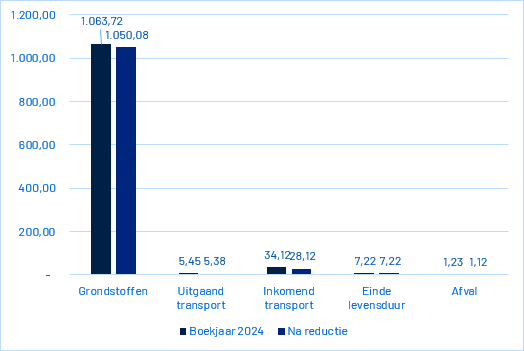
Evolution of emissions for the reduction scenario
Use of Farrow Flow Coupling
- Reduction of grit: The Farrow Flow coupling can help reduce grit through more efficient material flow and less wear and tear on equipment.
Chain objective
Iris chooses it because of its potential in CO2-reduction and the influence of Iris, in order to use the savings potential identified in the chain analysis on paint as a target for the chain. The target is as follows:
“Iris aims to reduce paint by 10% in 2027”
2025: analysis
2026: 5%
2027: 10%
FORWARD
Every year, a new energy assessment report (2.A.3) drawn up, which we will use to implement the new strategy. The way we communicate about our footprint, the objectives for the coming year, the actions and reduction measures that have been decided upon and implemented are described in our communication plan.
Through our innovation cell, we continue to actively search for solutions that support our sustainability strategy in the coming years to achieve further CO2 reduction and circularity. Be sure to check out our blogs as well as our posts on LinkedIn to inform you how we can do our part and also reduce your carbon footprint.
In addition, collaboration in the chain remains important for achieving CO2 reductions in the sector. Together with our chain partners, both clients and suppliers, we increase insight and develop innovative products. For this Iris Industry Solutions is a member of Netherlands carbon neutral because we are convinced that together with this valuable network of companies working on CO2 reduction, we are taking serious steps toward sustainability.
Since 2017, Iris Industry Solutions has been certified according to the CO2 performance ladder, for more information you can also visit our page on the website of Consulting SKAO. Our footprint was prepared in accordance with the ISO 14064-1 standard and is described in our procedure for energy reduction and reduction of CO2 emissions.
🌿 Review of the OnderhoudNL Industrial Event: Building sustainable solutions together
On Tuesday, June 3, Iris Industry Solutions had the pleasure of being represented at the MaintenanceNL Industrial Event - an inspiring day full of knowledge sharing, innovation and collaboration within the world of industrial maintenance.
Sustainability central
The event focused on sustainability. In particular, we had the opportunity to briefly explain the work of our Sustainability Working Group. Within this working group we are exploring, among other things, the concept of Conservation as a Service - an innovative form of collaboration aimed at extending the life of assets, reducing waste and encouraging circular processes.
This approach fits perfectly with our vision: maintenance should not only be technically effective, but also future-proof and socially responsible.
Valuable encounters
The event provided a unique opportunity to exchange ideas with industry colleagues and experts from, among others Rijkswaterstaat, who actively participate in various sustainability working groups. Their involvement and vision are of great value in our joint search for innovative solutions to tomorrow's challenges.
Thanks to the organization
Special thanks go to Ferdinand Wieman for the excellent organization of the event. Thanks to his efforts and those of the OnderhoudNL team, it was a day full of inspiration and connection.
Working together for a sustainable industry
At Iris Industry Solutions, we believe that collaboration is the key to sustainable innovation. We look forward to further translating the insights from this event into concrete actions within our projects and partnerships.
#OnderhoudNL #Rijkswaterstaat #Duurzaamheid #IndustrieelOnderhoud #ConservationAsAService #Samenwerking #Circularity #Assetmanagement #Innovation
🔗 Want to learn more about our vision for sustainability or collaborate on circular maintenance solutions? Please feel free to contact us!.

